Fire Safety Rules for Chemical Storage
A field guide to reducing fire risk in chemical storage: how to segregate materials, ventilate, equip the area for extinguishing and keep records that stand up to inspection.
 Yangın Takip Ekibi
Chemical storage fire safety rests on keeping materials that can react dangerously apart, removing ignition sources from the store, and providing suitable ventilation and extinguishing equipment. Each measure is set according to the product's safety data sheet, then maintained through regular checks and records. No single measure is enough; the safety comes from all of them working together.
On site, problems rarely come from large omissions. They come from small habits. A new product goes where an empty drum used to stand, a pallet aisle narrows because of stored goods, an extinguisher is taken away and never returned. A store is orderly when it is first set up. Fire risk grows when the store slowly drifts into "good enough".
This guide is written for facility and OHS managers, and for the fire safety teams who serve them. It explains what to check in a chemical store, in what order to proceed, and which mistakes cause problems at inspection, using concrete steps. For substance-specific limits, always rely on the relevant safety data sheet and current legislation.
What determines fire risk in a chemical store?
Three things determine fire risk in a chemical store: the hazard class of each stored substance, how close substances are to one another, and the ignition sources around them. A substance may not be dangerous alone. Put an oxidizer and a flammable liquid on the same shelf and the risk moves to a different level.
The first task is to know the hazard class of every product in the store. That information comes from the label on the packaging and from the product's safety data sheet. In Turkey, classification and labelling follow the Regulation on Classification, Labelling and Packaging (known as SEA). A product with an unreadable or damaged label, or one that has been transferred to another container, is treated as "unknown" in a risk assessment, and an unknown substance is handled under the worst-case assumption.
The second factor is ignition sources. Electrical panels, hot work, forklift charging points, static electricity and smoking habits come first. If maintenance requires hot work, it should not start until the store is emptied or a permit system is in operation.
The third factor is quantity. The more flammable material accumulates in one area, the faster a fire can grow and the harder it is to extinguish. So "it fits in the store" is not a sufficient test. Quantity, safe storage capacity and fire load are assessed together. The result should be written down and reviewed whenever a new product enters the store.
How are incompatible chemicals stored separately?
Incompatible chemicals are substances that can produce heat, flammable or toxic gas, or feed a fire when they touch each other, and they should be stored in separate areas, ideally divided by a physical barrier. Separation should not rely on a shelf label alone.
Start by grouping products by hazard class. In practice, these groups are managed separately:
- Flammable liquids and flammable gases
- Oxidizing substances
- Acids and bases (also separate from each other)
- Substances that react with water
- Toxic and corrosive substances
The relationship most often missed in this list is an oxidizer stored next to a flammable material. An oxidizer feeds a fire and makes it harder to put out. Keeping these two groups on the same shelf or in the same spill containment area is a typical non-conformity.
There are three ways to achieve separation. The first is physical separation, such as a separate room or cage. The second, if they share a room, is adequate distance and separate containment sumps. The third is fire-resistant storage cabinets. Which one to choose depends on the quantity and the substance. When deciding, read the storage and incompatibility section of the safety data sheet.
A common mistake is to organize the store alphabetically or by product family. Placing one supplier's products side by side looks easy, but it creates risk if their hazard classes differ. The layout should always follow hazard class.
Which fire precautions are needed in the storage environment?
The fire precautions of a chemical store consist of control of ignition sources, ventilation, suitable electrical installations and spill containment. These are the basic conditions of the store whatever substance is kept in it.
Ventilation prevents flammable vapor from building up. Vapors of liquids heavier than air collect at floor level, so the position of ventilation openings and whether they work should be checked. Ventilation is not something designed once and forgotten. A fan failure, a blocked vent or boxes stacked in front of an opening quietly reduce its effect.
On the electrical side, equipment of suitable type is expected wherever flammable vapor may be present. An ordinary socket or light fitting can be a spark source in an area with an explosive atmosphere risk. Classifying these areas and selecting equipment should be done by a competent engineer.
Spill containment is also part of fire safety. A flammable liquid that spills can spread beyond the store through floor slopes and drains and enlarge the fire. For this reason, drums and IBC containers should stand on a containment sump of suitable volume. The sump should be kept clean, and any accumulated liquid should be checked regularly.
Finally, there is housekeeping. Aisles should stay open, escape routes and exit doors should not be blocked, and packaging waste should not accumulate in the store. A disorderly store raises the risk of a fire both starting and growing.
What extinguishing equipment should a chemical store have?
Extinguishing equipment in a chemical store must be chosen to suit the way the stored substance burns. Not every fire is put out with the same extinguisher, and a wrong choice can make the situation worse.
For example, water-based extinguishing may be unsuitable in an area holding substances that react with water. For flammable liquid fires, methods such as foam or dry chemical powder come into play. Which system fits is taken from the firefighting section of each substance's safety data sheet and confirmed for the specific store with a fire safety specialist.
Once the equipment is installed, the following checks should be made regularly:
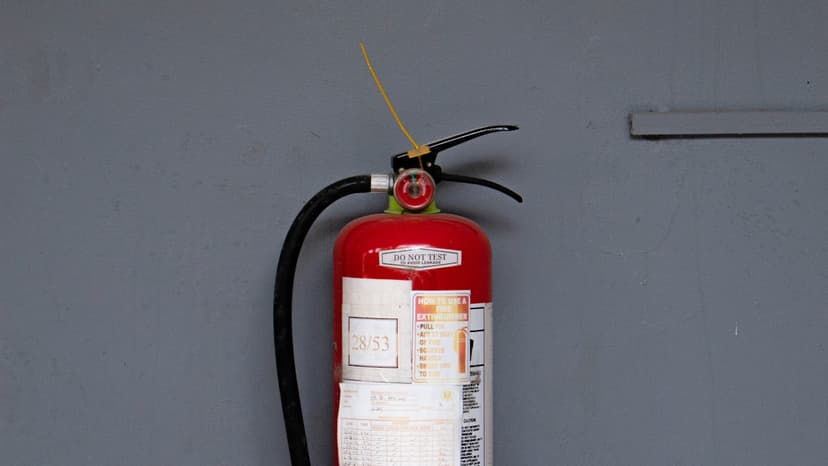
- Are extinguishers in place, visible and accessible?
- Are the pressure gauge and seal intact?
- Is the service and refill label up to date?
- Does the detection and alarm system cover the store?
- If there is an automatic extinguishing system, is it active and free of faults?
For the fire protection of buildings, the Regulation on Fire Protection of Buildings sets the basic framework. The conditions it requires for high fire load areas such as warehouses depend on the building's use class and size. Without quoting article numbers, it is enough to say that the design and the fire brigade's opinion should be prepared within that framework.
It is just as important that employees know how to use the equipment. A store that has extinguishers but no clear person to use them is not safe. This is why drills and training are an inseparable part of the equipment list.
How are labels, safety data sheets and records kept?
Record keeping in a chemical store means keeping the label, the safety data sheet and the inventory entry of every product consistent with one another. If the three do not match, problems appear at inspection, and during an incident there is a risk of the wrong response.
A simple record structure is enough to begin with. For each product, record the name, hazard class, storage location, date received, and where the safety data sheet can be found. The sheet should be reachable both as a printed copy at the store entrance and in electronic form. In an emergency, the team must not lose time looking for it.
Labels wear out often, so legibility is checked during periodic rounds. A product transferred to another container should also receive a suitable label. An unlabelled container is one of the most important points to watch.
The second group of records belongs to the fire equipment. Extinguisher checks, service and refill dates, alarm system tests and drill minutes should be tracked in one place. Scattered files and reliance on people's memory make inspection preparation harder.
Finally, to keep records current, the responsible person must be clear. Saying "everyone checks" in practice means nobody checks. The store manager should know in writing who fills in the checklist and how often.
How are periodic checks and internal audits carried out?
A periodic check is a review of the safe condition of the store at set intervals and against the same criteria. Its frequency is set by the organization's risk assessment and the relevant legislation. The aim is to see the problem before an incident does.
First, a checklist is prepared. It may include the following headings:
- Whether products are in the correct place for their hazard class
- Whether labels and safety data sheets are up to date
- Whether ventilation is working
- The condition of spill containment sumps
- Whether escape routes and aisles are clear
- The condition of extinguishing and alarm equipment
Then the check is carried out on site, working from the list. A round done from memory finishes quickly but leaves gaps. For each non-conformity found, a responsible person, a deadline and a closure record are written. A finding that is not closed will appear again at the next check and gives the inspector the impression of a store whose routine has not settled.
The value of an internal audit lies in seeing repeated findings. If the same fault appears in three checks in a row, the issue is the process, not the person. Then the layout, the training or the distribution of responsibility should be reconsidered.
Facilities that carry a major industrial accident risk may also have obligations under the Regulation on the Prevention of Major Industrial Accidents and the Mitigation of Their Effects. Whether a facility falls within that scope depends on the type and quantity of substances stored, and this assessment should be made with competent people.
How are the emergency plan and employee training set up?
An emergency plan for a chemical store is a written arrangement that defines in advance who does what in scenarios such as fire, spills and toxic gas release. The plan should work in people's heads, not just on a shelf.
The first step is defining scenarios. A small spill, an incipient fire, a major fire and toxic smoke are considered separately. For each scenario, the order of raising the alarm, evacuating, responding and calling outside help is written down. The information to be given to the fire brigade should be ready in advance: the stored substances, approximate quantities, the store plan and the location of critical valves.
The second step is training. Everyone working in the store should know how to read labels, find the key sections of a safety data sheet and use personal protective equipment correctly. New starters and temporary staff should not be left out of this training. Most accidents come not from someone who did not know the rule, but from someone who tried a "one-off" shortcut.
The third step is the drill. A drill tests not only evacuation but also whether the alarm is heard, the headcount at the assembly point and the accessibility of equipment. Afterwards the findings are written down and the plan is updated. A drill that is held but not recorded counts as not held at inspection.
The plan must also be updated together with changes. A new product group, a new store layout or a change of staff means the plan needs to be read again.
Conclusion
Fire safety in chemical storage is not an investment set up once and then left; it is an order that is restored every day. Separating products by hazard class, controlling ignition sources, keeping suitable extinguishing equipment ready and keeping records current are the four legs of that order. Gaps are usually hidden not in big decisions but in small items that nobody follows up.
The same principle applies to fire safety companies. When periodic check, service and refill dates at customer sites are tracked in scattered places, an overdue device is easily overlooked. At Yangın Takip, we offer software in which fire safety companies can follow their customer, facility, device and periodic maintenance records in one place. Even so, the most important step comes before any software: reviewing your store on site today, with a checklist in hand.
Related reading
Bring extinguisher and maintenance tracking into one place
Request a short demo for your company and see the system with your own data in a 14-day free trial.
Request a free demoFrequently Asked Questions
Can chemicals be stored together in the same store?
Only compatible ones can be stored together. Incompatible substances should be separated by a separate area, a physical barrier or a fire-resistant cabinet. Compatibility information is taken from the storage section of the product's safety data sheet.
Which fire extinguisher is used in a chemical store?
The extinguisher type is chosen according to how the stored substance burns. Water-based extinguishing may be unsuitable for substances that react with water. For the choice, check the firefighting section of the safety data sheet and consult a fire safety specialist.
Must a safety data sheet be kept in the store?
The safety data sheet for every product used in the store must be quickly reachable in an emergency. A printed copy can be kept at the store entrance and an electronic copy in an accessible place. Sheets should be matched with the current version from the supplier.
How often should a chemical store be checked for fire safety?
The frequency is set by the organization's risk assessment and the relevant legislation. What matters is that checks are done regularly with a written list and that findings are tracked until closed. An extra check after a major change is good practice.