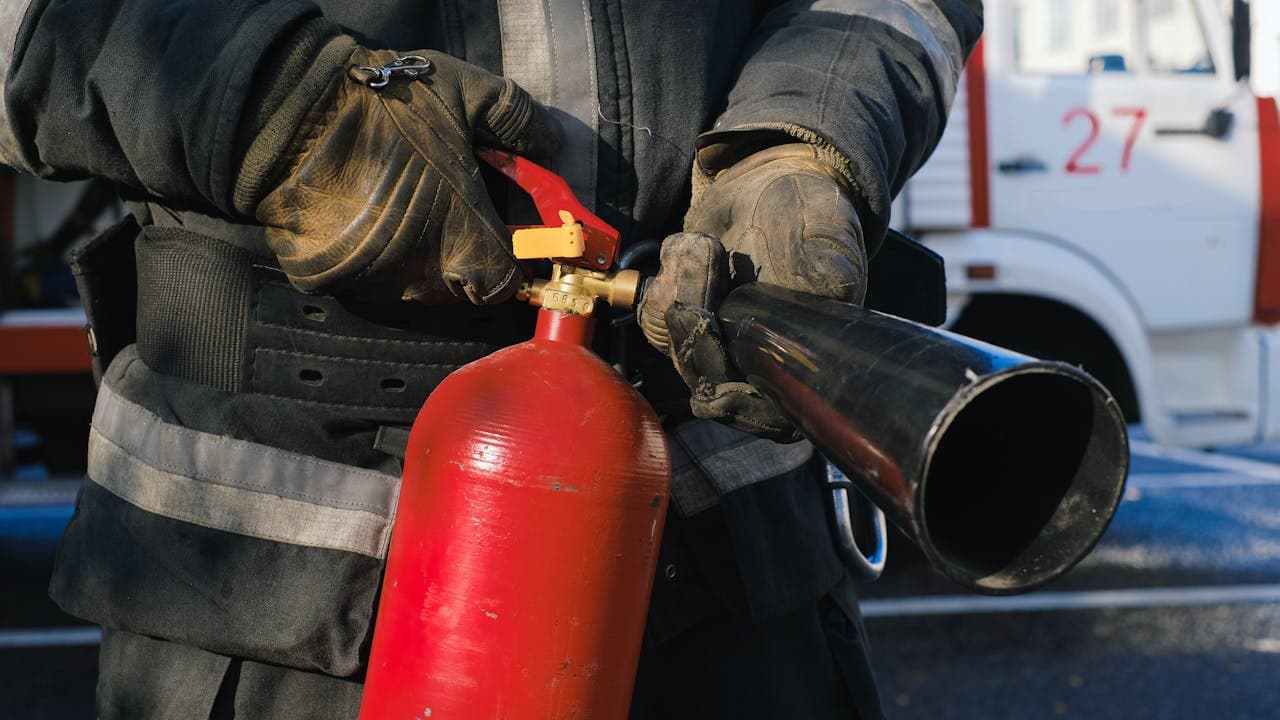
Fire Safety Measures on Construction Sites: A Practical Site Checklist
A practical sequence for construction site fire safety: hot work permits, flammable storage, extinguisher placement, temporary electrics, evacuation and record keeping.
 Yangın Takip Ekibi
Fire safety measures on a construction site are controlled storage of flammable materials, a hot work permit system, the right number and type of extinguishers, escape routes that stay clear, and trained workers. Because a site changes constantly, these measures are not set up once and forgotten; they are reviewed at every stage of the build.
In a finished building, the fire system is installed to a design and then enters periodic inspection. On a construction site, that system does not exist yet, the work area changes every week, and several subcontractors share the same ground. Welding, grinding, bitumen heating, temporary electrics and heavy packaging waste all appear at once. Most site fires start where these activities overlap without control.
This article follows a sequence you can apply on site: risk sources, hot work permits, storage, extinguisher placement, temporary electrics, evacuation and record keeping.
What are the main fire risk sources on a construction site?
Fire risk on a site comes from hot work, temporary electrical installations, flammable liquids and accumulated waste. Which of these dominates depends on the construction phase, so the risk assessment should be updated at every stage of the project.
During the rough construction phase, the biggest hazards are usually formwork timber, packaging and fuel storage. When finishing work begins, paint, thinner, adhesives, insulation foam and roof membranes come to the front. Many of these materials burn very fast and produce heavy smoke.
Hot work deserves its own heading. A welding spark, a grinding spark or a flame heater can ignite a combustible surface several metres away, and the fire may only show hours later. A common mistake is leaving the area the moment the job ends. A spark that has landed somewhere can smoulder unseen.
Temporary electrics are another unreliable source. Extension cables chained together, open panel covers, overloaded sockets and crushed cables are common defects on site. Moisture and dust make the risk worse.
Finally, there is the human factor. The number of people on site keeps changing, and a newcomer may not know the site rules. Undefined smoking areas, food heating and open flames used for warmth are frequent causes of site fires.
As a first step, walking the site and noting the dominant risk in each area is enough. That note sets the priority of the measures in the following sections.
How is a hot work permit applied?
A hot work permit is a written approval issued before any job that produces sparks or flame, such as welding, cutting or grinding. It records the location, time, responsible person and precautions on a single sheet.
Keep the permit form simple, otherwise it will not be filled in on site. The form should contain:
- The location and type of the work
- The start and end times
- The names of the worker and the fire watcher
- Confirmation that nearby flammable material has been removed
- The type and location of the extinguisher kept ready
First, flammable material around the work area is cleared away. Material that cannot be moved is covered with a non-combustible blanket. Because sparks can fall through gaps in floors and walls, the level below is also checked.
Next, a fire watcher is assigned. The watcher's only job is to observe; the same person cannot weld and keep watch at the same time. The watcher must know where the extinguisher is and how to use it.
Finally, a waiting period applies after the work ends. The area is observed for a while to check for hidden smouldering. How many minutes this period lasts should be written in the site's own procedure and set according to site conditions.
So that the permit system does not become a formality, the site manager or the OHS specialist should see the area in person before giving permission. A signed form for an area nobody has looked at proves nothing from a fire safety point of view.
Subcontractors should be told about this rule at the contract stage. A short briefing at site entry prevents disputes later.
How should flammable materials and waste be stored?
Flammable material storage means keeping products such as paint, thinner, fuel and gas cylinders in a ventilated area that is separate from the main structure and closed to unauthorised access. The aim is to keep the fuel under control if a fire starts.
Gas cylinders are stored upright and secured so they cannot fall. Full and empty cylinders are kept apart. Oxygen and fuel gas cylinders are stored away from each other, because an oxygen leak accelerates burning.
Paint and solvent containers are kept closed. Used rags soaked in solvent are not left in the open; they are collected in a metal container with a lid. These rags can heat up and ignite on their own, which makes them a common but overlooked risk.
Timber formwork, pallets and packaging waste should not be piled against the building facade. Collecting waste at a defined point every day and removing it from the site is safer than a large clean-up once a month.
Sites that store fuel also need ground protection against leaks. Spilled fuel is both a fire and an environmental problem. An extinguisher should be placed around the storage area, and the area should be marked.
Run these checks on the storage area every week:
- Are the doors locked and the warning signs in place
- Is the ventilation blocked
- Is there enough distance to the main structure and electrical panels
- Does the number of cylinders and containers match the record
Because the list is short, the site team can actually follow it.
Where and how many extinguishers should be kept on site?
On a construction site, extinguishers are kept near the points with the highest chance of fire, in visible places that are easy to reach. The exact number and capacity are determined by a risk assessment, based on the size of the area, the fire class and the applicable regulations.
Type selection depends on the hazard. For ordinary solid combustibles, dry powder extinguishers are a common choice. Next to an electrical panel, an extinguisher that does not conduct electricity is needed. Near liquid fuel storage, foam or powder types are suitable. If you are unsure, rely on the manufacturer's label and the opinion of an authorised service provider.
A few practical rules help with placement:
- Place the extinguisher on the escape route, close to an exit
- Keep an extra extinguisher ready at every hot work point
- Apply the same mounting height and signage across the whole site
- Do not let stacked material hide the extinguisher
As the site changes, the position of the extinguishers must change too. As floors go up, instead of moving extinguishers one by one, it is more orderly to draw a placement plan for each new floor. A common mistake is hanging the extinguisher on the first day and forgetting it; a few weeks later there is a pile of material in front of it.
The extinguisher itself is also checked. Look at the pressure gauge, the seal, the safety pin and the condition of the body. Dust and weather wear devices out quickly on a site. Maintenance and refilling should be carried out by an authorised company, and each device should carry a label showing its inspection date.
What precautions apply to temporary electrical installations?
A temporary electrical installation is the arrangement of panels, cables and sockets that runs the site until the permanent installation is in place. The key principle for fire safety is that it should be built as carefully as a permanent one.
First, panels must be closed, locked and protected from moisture. An open panel cover is both a fire and an electric shock risk. The area in front of the panel is always kept clear, because power may need to be cut in an emergency.
Next, the condition of the cables is checked. A worn, cut or tape-repaired cable is removed from the site. Cables lying across routes used by vehicles and loads lose their insulation over time. Where possible, cables are hung up or routed through protective conduits.
Overload is another common problem. Connecting several heaters, welding machines or chargers to one socket heats the cable. Stoves, electric heaters and similar devices should be used away from flammable material, fixed in place and supervised.
The installation should be built by a competent electrician, and changes should be made by the same person. Nobody on site should multiply a socket on their own initiative.
In the weekly check, the panel covers, the operation of residual current devices, cable joints and signs of heating are reviewed. If a socket or cable is found to be warm, its power is cut immediately and it is not used again until the cause is fixed.
How are evacuation routes and the emergency plan prepared?
A site emergency plan is a written arrangement that decides in advance who does what when a fire starts, where people gather and how the fire brigade is called. The plan should be posted where everyone can see it.
Evacuation routes are what fails most often on sites. Material is left in stairwells, temporary scaffold passages narrow down and doors stay locked. For this reason, a designated person should check at the start of every day that the escape routes are open.
The plan should include:
- The location and marking of the assembly point
- Phone numbers of the fire brigade and responsible people
- Who raises the fire alarm and how
- A headcount method to identify missing personnel
- Keeping vehicle access to the main road open
First, the method of raising the alarm is settled. On large sites an audible warning system is set up. On small sites a whistle or megaphone may be enough, as long as everyone knows about it.
Then comes the drill. A drill that stays on paper is useless. Short, realistic and repeated drills help workers act correctly in a moment of panic. Subcontractor workers should be included in the drills.
Finally, fire brigade access is considered. The site entrance and the nearby fire hydrant must not be blocked, and the road the fire engine will use must stay open. As the building rises, the evacuation route should be updated and explained to workers again.
How are worker training and daily checks set up?
Fire training on a site is short, regular instruction in which workers learn the fire risks of their own job, how to use an extinguisher and the evacuation rules. Examples specific to the job stay in memory longer than a generic presentation.
Every new worker receives a short orientation at site entry. It covers smoking areas, the assembly point, extinguisher locations and the hot work rule. This must include subcontractor workers, because they are often the group that is informed least.
Practice matters in periodic training. Letting people actually use an extinguisher is more effective than only explaining it. Depending on the work, emergency teams and first response staff are appointed on site. These teams should be assigned within the framework described in the relevant regulations.
Keep the daily check light. At the start of the shift, a responsible person walks the site with a short list:
- Are the escape routes open
- Are the extinguishers in place with the front clear
- Are jobs with hot work permits finished and the area safe
- Has waste built up
- Are the electrical panels closed
A deficiency found is closed the same day. If it cannot be closed, the person responsible and the date are written down. If this information stays in the logbook, you can also see whether the problem repeats.
Finally, build a culture of reporting. A worker who sees a hazard should not hesitate to say so. When corrective action is quick, people keep reporting; fear of punishment silences reports.
How are records kept and how do you prepare for an inspection?
A site fire safety record is the written evidence of the checks made, permits given and training delivered. Without records, the work cannot be proven at an inspection or after an incident.
The basic records to keep are:
- Hot work permit forms
- Extinguisher inspection and maintenance records
- Training and drill attendance lists
- Daily and weekly site check forms
- Detected deficiencies and their closing dates
First, give every extinguisher an identity. The number, location and last inspection date are tracked on one line. When a device moves, the record is updated. If the label and the record disagree, an inspector notices that first.
Then the records need to be gathered in one place. When scattered papers, photos on different phones and the site manager's notebook are not combined, nothing can be found on inspection day. Even a simple folder structure makes a difference.
In inspection preparation, official bodies assess the site against the regulations. For construction work, occupational health and safety legislation and fire protection legislation should be considered together. Confirm which article creates which obligation with your OHS specialist and from current legal texts.
Carry out your own internal audit before the inspection. Walk the site like an outsider and look for the gap between the records and the site. Finding the deficiency yourself before the inspector does is the cheapest route.
Conclusion
Fire safety measures on a construction site are not a one-time setup but an arrangement that is rebuilt every time the site changes. Knowing the risk sources, tying hot work to a permit, keeping storage under control, placing extinguishers correctly and keeping escape routes open all work together.
At Yangın Takip, we provide software that lets fire safety companies track customer, facility, device and periodic maintenance records in one place. The record and check routine in this article gains meaning through discipline on site, whatever tool is used to keep it.
Related reading
Bring extinguisher and maintenance tracking into one place
Request a short demo for your company and see the system with your own data in a 14-day free trial.
Request a free demoFrequently Asked Questions
Can people smoke on a construction site?
Only in a pre-defined area that is away from flammable material and has an extinguisher nearby. Smoking should be banned inside the building and in storage areas, and this rule should be explained to workers at entry.
What should be done first if a fire starts on a construction site?
First the alarm is raised and evacuation begins, then the fire brigade is called. If the fire is small and can be tackled safely, a first response is made with the right extinguisher; otherwise the area is evacuated.
How often should extinguishers be checked on a construction site?
Visual checks are done often with a simple list, while maintenance and refilling are carried out periodically by an authorised company. Dust and impact wear devices out quickly on site, so set the check frequency according to the risk of the work.
Do subcontractor workers have to attend fire training?
Yes, everyone working on site should know its emergency rules. It is recommended to give subcontractor workers a short orientation at entry and to keep a record of their drill attendance.
Related Posts

Warehouse Fire Safety Risks and How to Control Them: A Field Guide
September 15, 2026 · 9 min read

A Comprehensive Guide to Fire Safety Measures in Factories
August 17, 2026 · 9 min read
Parking Garage Fire Safety: Enclosed Garage Risks and New Hazards
November 6, 2026 · 6 min read