Periodic Fire Extinguisher Inspection Checklist: Monthly and Annual Items
An item-by-item checklist that separates monthly user checks from annual service maintenance, tracks refill and test dates on their own schedule and records every deficiency until it is closed.
 Yangın Takip Ekibi
Walk through a facility with a safety manager a week before an inspection and the same scene plays out again and again: the extinguishers are on their brackets, the labels are there, but there is no record showing when each unit was last checked or by whom. A periodic fire extinguisher inspection checklist closes exactly that gap. It settles in advance what to look at, how often to look at it and where a deficiency gets written down.
The problem is usually not that checks never happen. It is that different people check different things. One security guard only glances at the pressure gauge, another checks the pin, a third walks past without writing anything. The result is three different records for the same unit, or none at all. The inspector's question, meanwhile, is simple: when was this extinguisher last checked, and what condition was it in?
This article builds an item-by-item checklist that separates the monthly user inspection from the annual service maintenance. It also covers how to record each check, the mistakes that come up most often and how to draw a clear line of responsibility between the site and the service company.
Why monthly checks and annual maintenance are kept separate
Portable fire extinguishers involve two different jobs, and they are often confused. The first is the visual inspection carried out by the site's own staff. Is the unit in place, is it accessible, is it damaged, is the pressure right? These questions are answered by looking at the unit from the outside. The extinguisher is not opened or taken apart, and nobody touches the extinguishing agent inside.
The second is maintenance carried out by an authorised service provider. Here the unit is examined in more detail: parts are checked where needed, the condition of the agent and the propellant is assessed and the maintenance label is renewed. For portable extinguishers, the TS ISO 11602-2 standard provides the general framework for inspection and maintenance. In practice, user checks are done more frequently, while service maintenance is in most cases done once a year. The frequency can change depending on the facility's risk level and the regulations it falls under.
The practical reason for this split is responsibility. Handing the monthly check to the service company is both costly and unnecessary; the service team is not on site every month. Handing annual maintenance to in-house staff, on the other hand, means giving a job that requires authorisation and equipment to people who are not equipped for it. Splitting the checklist in two makes it clear from the start who owns each item.
- Monthly check: site staff, visual, recorded
- Annual maintenance: authorised service, detailed examination, label renewed
- Refilling and hydrostatic testing: depends on unit type and age, tracked on a separate schedule
The monthly periodic fire extinguisher inspection checklist
The purpose of the monthly check is to confirm from the outside that the unit will work when it is needed. The list has to stay short so that it actually gets used. Items that take no more than a minute or two per unit and can be answered with yes or no work best.
Start with the location. Is the unit at the point shown on the layout plan, is it on its bracket, is it blocked by goods, pallets or furniture? An extinguisher that has been moved somewhere else is a unit that exists on paper but cannot be found on the floor. Next, check the signage: is the sign showing where the unit is still clearly visible?
Then move on to the unit itself. The following items make a sufficient baseline for most sites:
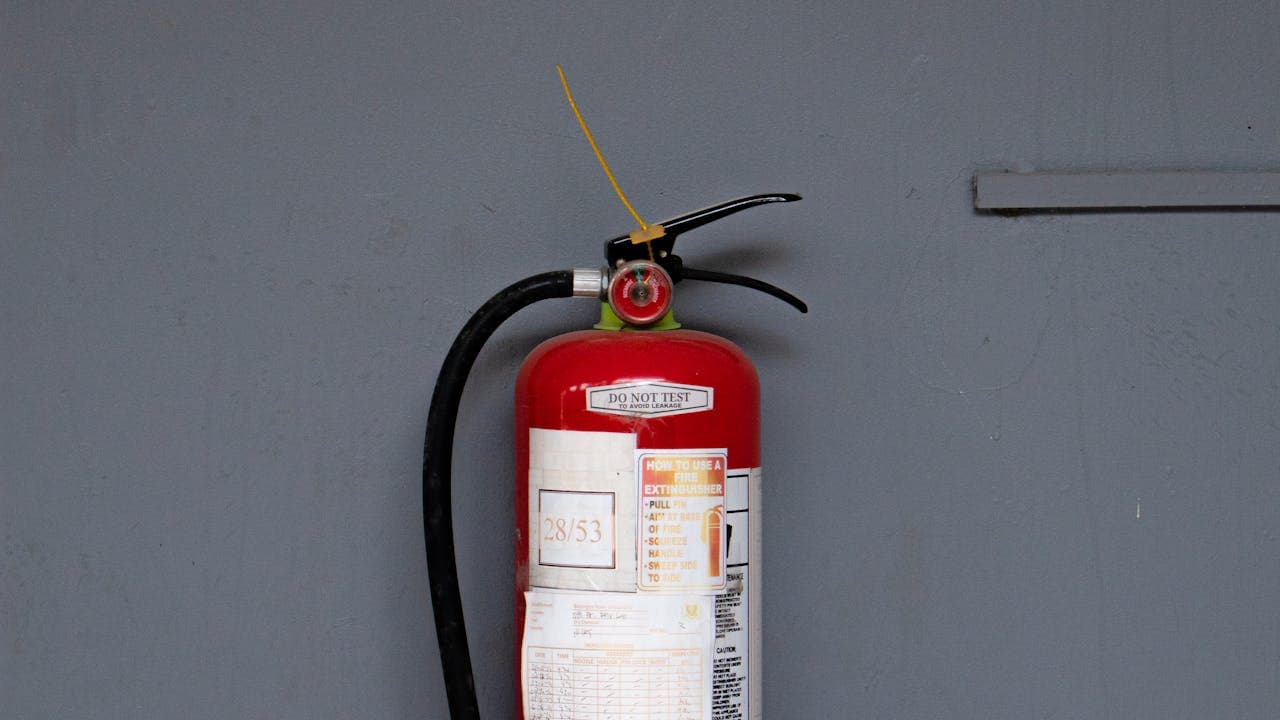
- Is the safety pin in place and the tamper seal intact
- Is the gauge needle in the green zone (on units with a gauge)
- Are there dents, corrosion, rust or blistered paint on the body
- Are the hose and nozzle in place, free of cracks and not blocked
- Is the operating instructions label legible
- Is the service maintenance label present and the last service date readable
- Does the unit look as if it has been used or discharged
Finally, record the check. The name of the person who carried it out, the date and any deficiency found must always be written down. Even if nothing is wrong, the unit should be marked as compliant, because a blank line is read during an inspection as a check that never happened.
What annual service maintenance looks at
Annual maintenance reveals what the monthly check cannot see. A unit that looks fine from the outside may have agent that has caked, propellant that has leaked or valve parts that have worn. That is why annual maintenance should be done by an authorised service provider with the proper equipment.
The scope of maintenance varies by unit type. Dry chemical powder, CO2, foam and water-based extinguishers each have their own checkpoints. For example, weight checks are central for CO2 units, while the flowability of the powder matters most for dry powder units. What the site needs to know is that the service form states in writing which operations the maintenance covered. A one-line form that says "maintenance done" does not show what was actually checked.
After service maintenance, it is useful for the site to confirm the following items on its own checklist:
- Has every unit received a new maintenance label with the correct date
- Does the service form list unit serial numbers or inventory numbers
- Are units flagged as needing refilling or testing listed separately
- Were temporary units put in place of those taken off site during maintenance
- Have units taken out of service been labelled and set aside
The fourth item deserves particular attention. If the spot of a unit taken away for refilling stays empty for several days, that area is effectively unprotected. When maintenance is planned, the question of replacement units should be agreed with the service company in advance.
Track the refilling and testing schedule separately
The part of the checklist that is most often skipped is the refilling and hydrostatic testing schedule, which runs independently of annual maintenance. Depending on the agent type and the unit's manufacturing date, refilling and pressure vessel testing are required at certain intervals. These intervals differ by unit type, so applying a single date to every unit is not correct.
In practice, the best approach is to keep three separate dates for each unit: last maintenance, last refill and last test. The maintenance label usually shows only the first. The other two stay in the service records and get missed unless someone looks for them. It is common to find a unit whose maintenance looks current while its refill date passed long ago.
When setting up this schedule, answer the following questions:
- Are the type and year of manufacture known for every unit in the inventory
- Are the last refill and last test dates recorded, or only printed on the label
- Can you list the units whose refill or test date falls within the next three months
- Have units at the end of their service life been identified and added to a replacement plan
These questions are usually hard to answer with paper forms. As the number of units grows, keeping an inventory-based record becomes unavoidable, rather than reading dates off labels one by one.
How to keep the inspection record
Even if a check was done, without a record it counts as not done for inspection purposes. That makes the record format as important as the check itself. A good record answers these questions: which unit, when, by whom and with what result.
The first condition for unit-based records is that every unit has a unique number. Descriptions such as "the extinguisher by the warehouse entrance" lose their meaning as soon as the unit is moved. The inventory number should be marked on the unit and on the layout plan, and every check should be recorded against that number. That way a unit's history can be followed regardless of where it currently sits.
The record form should contain at least the following fields:
- Inventory number and unit type
- Location
- Check date and the person who checked
- A compliant / non-compliant mark for each checklist item
- A description of any deficiency found
- The date the deficiency was closed and who closed it
The last two fields are missing from most forms, yet they are the most important. The record of a unit found with its gauge in the red shows when the problem was noticed. If it does not show when the problem was fixed, it remains an open deficiency during an inspection. An inspection record should be thought of not as a finding sheet, but as a work list in which every deficiency is tracked until it is closed.
Common mistakes
Even when the checklist looks tidy on paper, some mistakes come up on site again and again. Most of them stem not from bad intent but from a routine that slowly loosens over time.
The first mistake is looking only at the gauge. A needle in the green does not on its own show that the unit is usable. A unit with a cracked hose, a blocked nozzle or goods stacked in front of it will fail when needed, even with the right pressure. That is why each item on the list must be marked separately.
The second mistake is filling in check dates in bulk. When every row gets the same date and the same signature at the end of the month, the record no longer reflects a real walk-round. An experienced inspector spots this easily. Doing the check on site, at the unit, and recording it on the spot both improves reliability and reduces the chance of a unit being missed.
The third mistake is recording a deficiency and leaving it there. If a unit noted as "pin missing" is logged with the same note the following month, the checklist is not doing its job. When a deficiency is found, who it is reported to and how quickly it must be closed should be decided in advance.
- Looking only at the gauge and skipping the other items
- Entering checks in bulk at the end of the month
- Writing down a deficiency without tracking it to closure
- Not updating the inventory when units are moved
- Treating the service label as a substitute for the check
Make the division of work with the service company explicit
For the checklist to work on site, the division of work between the facility and the service company has to be clear. Monthly checks stay with the site and annual maintenance stays with the service provider, but if the handovers between the two are vague, deficiencies end up belonging to nobody.
First, ask the service company for a unit-based report at the end of every maintenance visit. The report should include inventory numbers, the work carried out, any refilling or testing needs and the units taken out of service. Then compare that report with your own inventory. Units that appear in the service report but not on site, or on site but not in the service report, are the first sign of inconsistent records.
On the service company's side, the situation is the same in reverse. A fire safety company tracks hundreds of units across dozens of customers. Knowing which unit at which facility of which customer account is approaching its refill date is the foundation of planned maintenance. Notifying the customer before the date arrives directly affects both service quality and work planning.
- Site: monthly check, deficiency reporting, keeping the inventory current
- Service: annual maintenance, refilling, testing, unit-based report
- Shared: replacement unit plan, sharing maintenance dates in advance
Conclusion
Checking fire extinguishers is not complicated; the hard part is keeping it up every month with the same discipline and a proper record. Separating the monthly visual check from annual service maintenance, tracking refill and test dates on their own schedule and following every deficiency through to closure means the answers to an inspector's questions are ready before they are asked.
Keep the checklist short, give every unit a unique number and record the check on site, at the unit. These three habits prevent a system that looks tidy on paper but does not work on the floor.
At Yangın Takip, we work so that fire safety companies can follow their customer accounts, facilities and equipment inventory, periodic maintenance and refill dates and field inspections in one place; the checklist in this article grew out of that same need we see on site.
Related reading
- Yangın söndürücü dolum süresi ne zaman gelir? (TS ISO 11602-2) — https://yangintakip.com/en/blog/yangin-sondurucu-dolum-suresi-ts-iso-11602-2-rehberi
- Yangın Söndürücü Çeşitleri ve Kullanım Alanları Rehberi — https://yangintakip.com/en/blog/yangin-sondurucu-cesitleri-ve-kullanim-alanlari-rehberi
- Periodic Maintenance Software — https://yangintakip.com/en/cozumler/periyodik-bakim-yazilimi
Bring extinguisher and maintenance tracking into one place
Request a short demo for your company and see the system with your own data in a 14-day free trial.
Request a free demoFrequently Asked Questions
Should a fire extinguisher be checked every month?
Yes, a monthly visual check by site staff is common practice. The check covers the unit's location, pin, gauge, hose and body from the outside, and the result is recorded. Higher-risk areas may need more frequent checks.
Who is allowed to service a fire extinguisher?
Detailed maintenance, refilling and testing should be carried out by an authorised service provider. Site staff only perform visual checks; they do not open the unit or handle the extinguishing agent. The service provider should be asked for a unit-based report after every maintenance visit.
If the gauge is in the green, is the extinguisher usable?
Not on its own. Even with the right pressure, a unit with a missing pin, a cracked hose or a blocked nozzle may fail when needed. That is why the other checklist items must also be marked separately.
What should a fire extinguisher inspection form include?
It should include the inventory number, unit type, location, check date, the person who checked and a compliant/non-compliant mark for each item. A description of any deficiency and the date it was closed should also be on the form. That way the record shows the deficiency being tracked until it is closed.