
Fire Extinguisher Mounting Height: The Regulatory Rule and a Placement Guide
A step-by-step guide to fire extinguisher mounting height: the regulation's 90 cm rule, the measurement point, placement by weight class, the 25 metre travel distance, and a post-installation checklist.
 Yangın Takip Ekibi
One of the most common corrective actions written up during a fire safety inspection has nothing to do with the extinguisher itself. The cylinder is full, the label is current, the seal is intact; but the unit is behind a door, on top of a shelf, or simply standing on the floor in the middle of a corridor. Fire extinguisher mounting height and placement is, for exactly this reason, one of the questions that fire safety service companies and facility managers ask most often.
The problem is usually not a lack of knowledge but a lack of clarity. The regulation gives a measurement; but details such as which point on the extinguisher the measurement is taken from, what changes for light and heavy units, and where the sign should go are interpreted differently from one person to the next. The result is a facility where one department has extinguishers mounted at 90 cm and another at 140 cm, followed by a non-conformity recorded during the inspection.
This guide covers what the regulation actually says about mounting height, how to take the measurement, how to decide placement by weight class, the rules on travel distance and signage, the mistakes that keep repeating, and a post-installation checklist. The goal is to hang every unit in the right place the first time and to document it.
What the regulation says about fire extinguisher mounting height
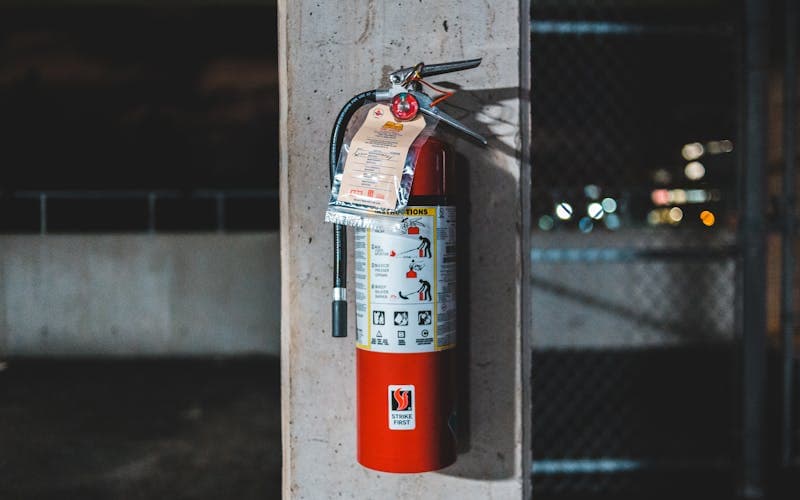
In Turkey, the primary text governing the placement of portable extinguishers is the Regulation on Fire Protection of Buildings. Article 99 of the regulation, which deals with portable extinguishing equipment, sets three concrete rules for mounting. First, the wall bracket hook holding the extinguisher must be positioned so that the unit can be lifted off the wall easily. Second, units heavier than 4 kg and lighter than 12 kg must be mounted so that their height above the floor does not exceed roughly 90 cm. Third, the travel distance from any point to the nearest extinguisher must not exceed 25 metres.
Understanding the logic behind these three rules makes it much easier to resolve the grey areas you will meet on site. The height limit exists so that anyone can grip the unit and lift it off in a moment of panic. A full 6 kg dry chemical powder extinguisher pulled down from shoulder height carries both a drop risk and an injury risk. The requirement that the hook release easily serves the same purpose: the unit should come into your hands in a single movement, without any effort to free it from the bracket.
The regulation also requires extinguishers to be placed near passageways, distributed evenly, clearly marked, and located where they can be reached easily at all times. Placing them inside or next to fire hose cabinets falls within this scope. Mounting height is therefore not a standalone number; it is a placement decision evaluated together with accessibility, visibility, and distribution rules. Inspectors examine the whole picture: if the unit is at the right height but its front is blocked or the sign is missing, the non-conformity is still written up.
Which point should you measure from?
The most debated question on site is which point on the extinguisher the 90 cm measurement refers to. The regulation text says the height above the floor should not exceed roughly 90 cm; it does not define the reference point separately. This ambiguity means the same unit can be judged compliant by one inspector and too high by another. The common field interpretation is that the highest point of the unit, meaning the valve or carrying handle, should not exceed roughly 90 cm above the floor. Some practitioners instead use the position of the hanging ring; depending on the cylinder length, the difference between these two readings is significant.
The way to eliminate this ambiguity at facility level is to pick a single measurement point and write it into your procedure. Our recommendation is to choose the most conservative interpretation: use the highest point of the unit. That way the extinguisher stays under the limit no matter which inspector visits. State the measurement point explicitly in the procedure, brief the installation team the same way, and photograph the first installation for the record. The word roughly in the regulation allows a few centimetres of tolerance; but do not use that tolerance as a defence for overruns of 100 cm or 110 cm that anyone can measure at a glance.
Follow this sequence when measuring:
- First, measure from the finished floor surface; if you measure from the screed and flooring is laid afterwards, the unit ends up lower, and carpet or raised flooring changes the reading as well.
- Next, measure with the extinguisher actually hanging on the bracket; the height of an empty bracket does not tell you where the unit will sit.
- Finally, use a tape measure rather than eyeballing it; 6 kg and 12 kg cylinders differ in length, so the same bracket height gives two different results on two units.
Repeating these steps at every installation takes a few minutes; it is far cheaper than dealing with a height non-conformity report after an inspection.
Placement by weight class: light, medium, and heavy units
The 90 cm limit in the regulation is written only for units between 4 kg and 12 kg. No separate figure is given for units outside that range; the decision is made on the basis of the unit's weight and how it is used. Splitting your facility inventory into three groups makes the decision easier.
Units under 4 kg
For small vehicle-type units or 1-2 kg extinguishers, the regulation sets no upper limit. Apply the same logic anyway: the unit should be easy to see and removable in one movement. These units are typically found in vehicles, small office kitchens, or next to electrical panels. Mounting them well above eye level may seem to improve visibility, but it puts them out of reach of shorter staff. The general practice is to keep these units close to or below the 90 cm line as well.
Units between 4 kg and 12 kg
This is the most common group in facilities: 6 kg and 12 kg dry chemical powder extinguishers and 5 kg carbon dioxide units fall into this range. For them the rule is clear: wall-mounted on a bracket, with the highest point not exceeding roughly 90 cm. They are not left on the floor, not placed on shelves, and not put on top of cabinets.
Units over 12 kg and wheeled units
Wheeled units of 25 kg or 50 kg, along with cylinders heavier than 12 kg, are not wall-mounted. They stand on the floor on their own wheeled trolley or base plate. Here the issue is not height but position: the front of the unit and its pulling direction must be clear, the wheels must sit on the floor, and the unit must be protected from forklift or vehicle traffic. Because the regulation separately requires wheeled units in car parks, warehouses, plant rooms and similar areas, the placement plan for these areas should be drawn up in advance.
Travel distance, visibility, and signage
An extinguisher mounted at the correct height is useless if it is in the wrong place. The regulation sets the maximum travel distance from any point to an extinguisher at 25 metres. This is walking distance, not a straight line: racks, machines, and closed doors lengthen the route. When you plan placement, draw the real walking routes on the floor plan; drawing circles around each unit in large open spaces can be misleading.
Extinguishers are positioned along escape routes, near exit doors, and in passageways. The reason is simple: in a fire, people move toward the exit; someone who finds the extinguisher on the way out can intervene and still retreat if necessary. Reaching a unit hung in the far corner of a room means walking past the fire, and nobody does that. So once you have settled the mounting height, give the location decision the same level of care.
Signage is an inseparable part of visibility. Under the Regulation on Health and Safety Signs, a sign with a white pictogram on a red background is used to indicate the extinguisher location. The sign is hung above the unit at a height that can be seen from a distance along the corridor; slightly above eye level is the usual choice. Placing the sign directly above the unit lets someone looking from afar find the extinguisher even when it is hidden behind a rack or a machine. In long corridors and large warehouses, double-sided signs mounted perpendicular to the wall work better than flat single-sided ones.
Check the following points:
- Is there enough clear space in front of the unit for a person to stand comfortably and take it?
- Is the sign visible from both ends of the corridor?
- Does the door cover the unit or the sign when it is open?
- Is the unit in a spot that could be blocked by temporary storage, pallets, or a cable reel?
Brackets, cabinets, and stands: what to check for each mounting type
The installation itself is inspected as closely as the mounting height. The bracket must be rated for the unit's weight and fixed with anchors suited to the wall type. On concrete or brick, steel anchors are sufficient. On plasterboard, a standard anchor loosens over time; a 6 kg unit tearing out of plasterboard and falling damages both the extinguisher and the person nearby. Use dedicated heavy-duty plasterboard anchors or align the bracket with a stud inside the wall.
The bracket hook must fully engage the extinguisher's hanging ring without trapping the unit. The regulation's requirement that the unit be easily removable from the wall means exactly this. In some installations the extinguisher is strapped tightly into a belted bracket, and in an emergency someone ends up fighting with the buckle; such fixings prevent the unit from falling but make it harder to take. Avoid belted brackets outside vehicles and high-vibration environments.
Outdoors, in wash-down areas, and on dusty production floors, extinguishers are kept inside protective cabinets. The same height logic applies to a unit inside a cabinet: the cabinet shelf or hook must keep the unit below the 90 cm line. The cabinet door must not be locked; it should be closed with a breakable seal or a free-swinging door. The door's opening direction must not narrow the corridor or the escape route.
Stands and base plates come into play in glass-partitioned offices where walls cannot be drilled, in leased premises, and with wheeled units. A unit on a stand sits at floor level, so height is not an issue; but the stand must be stable against tipping and the unit must be secured to it. Place the stand against the wall and below the sign, not in the middle of the walkway.
Common mounting mistakes and why they happen
The same mistakes repeat across different facilities. Knowing them together with the reason they are mistakes helps your team develop the right reflexes during installation.
Hanging the unit at eye level. This is the most common error. The reasoning is usually that it will be more visible. But visibility is the sign's job, not the extinguisher's. A 12 kg unit hung at 130-140 cm is hard for most staff to bring down and is clearly above the regulatory limit.
Leaving the unit on the floor. Putting the extinguisher on the floor until a bracket arrives turns into a habit. A floor-standing unit gets kicked, pushed by pallets, moved during cleaning, and its base corrodes from moisture. For units between 4 kg and 12 kg, leaving them on the floor is a non-conformity; the bracket must arrive with the installation.
Mounting behind a door. When the door is open, it completely hides the unit. Because doors are open most of the time, the extinguisher effectively becomes invisible. Mount the unit on the wall opposite the door's swing, where the door leaf cannot cover it.
Ignoring raised flooring. Server rooms and some production areas have raised floors. A 90 cm measurement taken from the concrete can drop to 60 cm once the floor is installed; the unit is then low, which is not a problem in itself, but the sign alignment is thrown off. In the reverse case, removing the floor pushes the unit above the limit.
Choosing a bracket that does not match the unit. Hanging a 12 kg extinguisher on a bracket made for a 6 kg unit bends the hook. Use the bracket recommended by the manufacturer for each unit and record the weight class in the installation log.
Treating placement as a one-off task. Rack layouts change, new machines arrive, partition walls are built. A location that was correct six months ago may now be behind a rack. Make placement part of the periodic inspection.
Post-installation checklist and records
Finishing the installation does not mean the job is done; unless it is documented, you have no evidence at the inspection. Apply the following list to each unit individually and record the result on the unit's card.
- The highest point of the unit does not exceed roughly 90 cm, measured from the reference point defined in the facility procedure.
- The bracket is fixed with anchors suited to the wall type; it does not move when the hanging unit is pulled by hand.
- The unit can be taken off the bracket in one movement; there is no strap, lock, or jamming.
- There is clear space in front of the unit; no door, rack, pallet, or machine covers it.
- The extinguisher sign is above the unit at a height visible from both directions along the corridor.
- The unit's label, seal, pressure gauge, and last inspection date are legible.
- The unit's location is marked on the facility layout plan and matches the number on the floor plan.
- The installation date, the installer, and a photo of the location have been recorded.
The most practical way to keep records is to give each unit a single identification number within the facility and to mark that number both on the unit and on the layout plan. When a unit is taken away for refilling, a temporary unit is left in its place; because the identification number stays fixed, there is no confusion about which unit belongs at which point. The location photo is your strongest evidence during an inspection and in disputes with a customer who claims the unit was never hung there.
During periodic inspections, check the placement as well as the unit. The service technician should record the height, the sign, and the access during the annual inspection and report any non-conformity to the customer in writing. This documents the service company's responsibility and gives the facility manager a concrete list of corrections. Reporting placement non-conformities under a separate heading makes it easier to prioritise what needs fixing before an inspection.
Conclusion
Fire extinguisher mounting height may look like a single number, but on site it only makes sense together with access, visibility, weight class, and record-keeping discipline. Tie the roughly 90 cm rule to a single measurement point in your procedure, put units on brackets or stands according to their weight group, calculate the 25 metre travel distance along real walking routes, and document every installation with a photo. These four habits eliminate most of the placement non-conformities that inspectors write up.
At Yangın Takip, we help fire safety service companies track their customer, facility and inventory records, each unit's location, its periodic inspection date, and its installation photo in one place; that way, placement non-conformities surface during the site visit rather than during the inspection.
Related reading
- Yangın söndürücü dolum süresi ne zaman gelir? (TS ISO 11602-2) — https://yangintakip.com/en/blog/yangin-sondurucu-dolum-suresi-ts-iso-11602-2-rehberi
- Yangın Söndürücü Çeşitleri ve Kullanım Alanları Rehberi — https://yangintakip.com/en/blog/yangin-sondurucu-cesitleri-ve-kullanim-alanlari-rehberi
- Periodic Maintenance Software — https://yangintakip.com/en/cozumler/periyodik-bakim-yazilimi
Ready for digital transformation in fire safety?
Try free for 14 days. No credit card required.
Start Free TrialFrequently Asked Questions
How high off the floor should a fire extinguisher be mounted?
Under Turkey's Regulation on Fire Protection of Buildings, units heavier than 4 kg and lighter than 12 kg must not exceed roughly 90 cm above the floor. Because the regulation does not define the measurement point, set a single reference point in your facility procedure; the safest interpretation is the highest point of the unit.
Can a fire extinguisher be placed on the floor?
Units between 4 kg and 12 kg are not left on the floor; they are wall-mounted on a bracket. Wheeled units and units heavier than 12 kg stand on the floor on their own trolley or base plate. Where walls cannot be drilled, a secured stand can be used.
At what height should a fire extinguisher sign be hung?
The sign goes directly above the unit at a height visible from both ends of the corridor; slightly above eye level is the usual choice. The regulation gives no fixed measurement for sign height; the criterion is visibility from a distance. In long corridors and warehouses, a double-sided sign mounted perpendicular to the wall works better.
How far apart should two fire extinguishers be?
The regulation defines travel distance rather than spacing between units: the walking distance from any point to the nearest extinguisher must not exceed 25 metres. Calculate this along real walking routes on the floor plan; racks and closed doors lengthen the route.
Is a wall bracket mandatory for a fire extinguisher?
Every wall-mounted unit needs a bracket; the regulation requires the hanging ring to be positioned so the unit can be lifted off the wall easily. The bracket must match the unit's weight class and be anchored according to the wall type. On plasterboard, heavy-duty anchors or mounting into a stud is essential.
Related Posts

How to Prepare a Hospital Fire Safety Plan: Evacuation, Teams and Drills
September 12, 2026 · 9 min read

Is a Fire Extinguisher Mandatory in the Workplace in Turkey? Regulation, Responsibility and Inspection
September 11, 2026 · 9 min read
How to Use a Fire Extinguisher: The Steps and the Common Mistakes
September 10, 2026 · 8 min read